
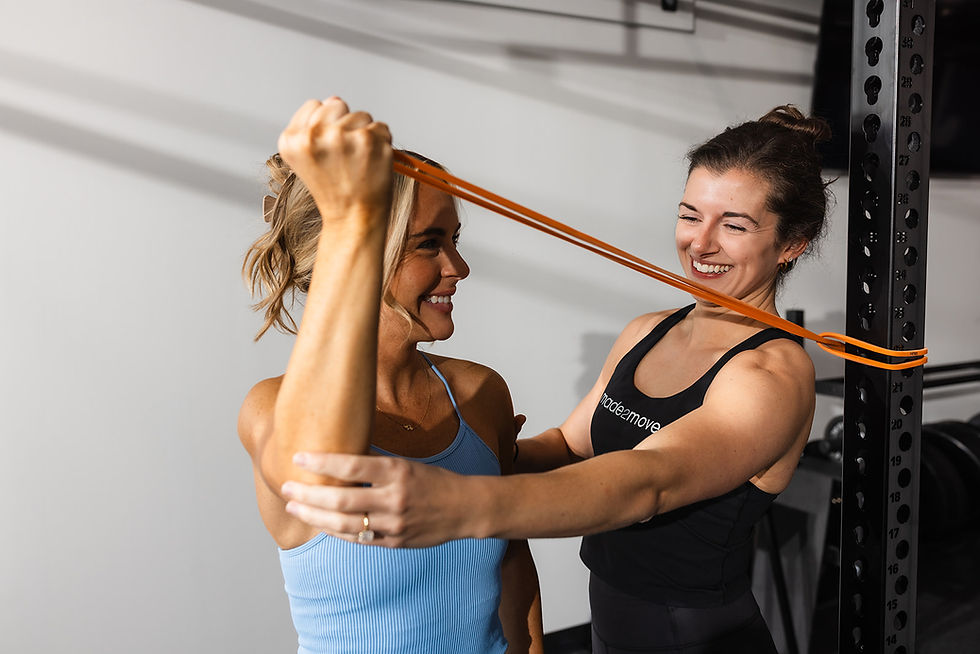
Don't let pain hold you back from doing
what you love.
When you hear the words "rotator cuff tear," most people picture a piece of paper ripped in half. But a rotator cuff tear is more like a quilt with some fibers fraying. You still have lots of fibers. Multiple muscles sharing the load. The quilt still works.
And yet — that word "tear" sends most people straight to a surgeon's office, or into months of avoiding moving their shoulder entirely.
Here's what we actually know: nearly half of rotator cuff tears exist in people with zero pain or limitations. Imaging is a snapshot — it doesn't predict your future or determine what you can do.
Your MRI is not a crystal ball.
What we see constantly is this: someone has shoulder pain, gets imaging, is shown all their "imperfections," gets scared, stops using their shoulder — and then wonders why it keeps getting weaker and more painful. Fear and pain are best friends. They fire each other up.
Pain free is not the finish line. Getting strong enough to do everything you love is.
Imagine working out without worrying about shoulder pain.

This is for you if:
• You have shoulder pain — from a rotator cuff issue, impingement, or just something that won't go away — and it's keeping you out of the gym or limiting your training
• You've been told surgery is your only option and you're not ready to accept that
• You tried band exercises and basic PT, felt better for a while, then hit a plateau and went right back to where you started
• You're a CrossFitter, lifter, or overhead athlete who wants to get back to pull ups, pressing, snatches, or ring work — not just "functional" movement
• You stopped lifting overhead, avoided certain movements, or started working around your shoulder — and you're ready to stop doing that
• You were told to just rest it — and it only got worse
HOW WE WORK WITH SHOULDER PAIN
When a Charlotte patient comes to us with shoulder pain, we start with a full assessment — not just what hurts, but what your shoulder isn't prepared to handle and why.
Then we follow a three-phase approach:
Phase 1: Calm it down without making you more afraid. You keep moving. We modify, not eliminate. The goal is to find what your shoulder can tolerate and build from there.
Phase 2: Build capacity. Progressive loading through the movements you've been avoiding. This is where most PT fails — it never gets past band work. We progress deliberately until your shoulder can handle real loads again.
Phase 3: Return to everything. CrossFit, golf, overhead pressing, whatever your goals are. Pain free is a checkpoint, not the finish line.
One of our Charlotte patients came in with limited range of motion, unable to fully participate in CrossFit. Another had been managing a nagging shoulder injury for over 3 years. Both left stronger, more confident, and back to doing everything they loved.
After a 90 minute assessment with a Doctor of Physical Therapy, we'll build you a plan that not only solves your pain, but prevents it from coming back.
From Our Patients

One of our Charlotte patients came to us unable to fully participate in CrossFit. Her right shoulder had limited range of motion and consistent pain — the kind that makes you modify every workout and wonder if you'll ever get back to training normally.
Working with Emily, she rebuilt her strength, her range of motion, and her confidence in the gym.
"Emily was so helpful. She is very knowledgeable and helped me to regain strength and range of motion in my shoulder. She gave me exercises to do at home that I still do."
Still doing the exercises. That's the difference between PT that patches you up and PT that actually changes things.
Other Services

ACL Rehab

HYROX & Group Fitness Rehab


About the Author
Hannah Breal, PT, DPT is the co-owner of Made2Move Physical Therapy and author of Letters on Pain, Movement & Health — a weekly newsletter for athletes and active adults who want to move better and stay healthy for life.

KEEP LEARNING.
KEEP GROWING.